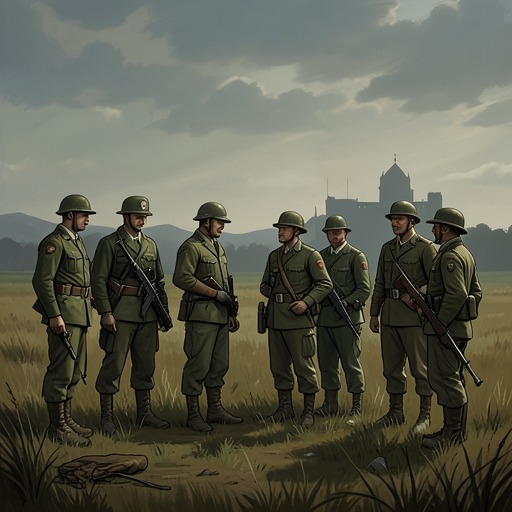
United States Assault Team (D-boys)
Black Hawk DownThe D-boys were the elite commando unit at the center of the October 3, 1993, raid on a gathering of Habr Gidir clan leaders in Mogadishu. Their assignment was to storm the target house and seize two of Mohamed Farrah Aidid’s senior lieutenants, but the operation depended on a coordinated force of helicopters, Rangers, and vehicles—and soon unfolded amid mounting resistance and battlefield confusion.
Mission and Organization
The raid was designed as a rapid capture operation. While the commandos assaulted the target house, four helicopter loads of Rangers were to descend at the four corners of the surrounding block and establish a perimeter, preventing anyone from entering or leaving. The prisoners and assault team would then be escorted back to base. The planned force combined roughly 75 Rangers and 40 commando troops in 17 helicopters. A separate convoy of 12 vehicles waited at the airport, ready to travel the three miles to the target building and bring the prisoners and assault team back. The launch code was “Irene.” These numbers and assignments show how the commando assault depended on several coordinated elements: the D-boys would enter the house, while the Rangers secured the surrounding streets and the convoy provided the planned route out.
Combat Support and Movement Under Fire
The D-boys’ work extended beyond the assault on the target house. One vehicle carrying commandos and naval special-operations troops raced ahead of the convoy to join the assault team as it restrained 24 Somalis inside. During the approach, a shot struck John Gay in the hip. Tim Martin opened Gay’s trousers and found that the bullet had hit his knife, shattering its blade and deflecting the round. After Martin removed fragments and bandaged him, Gay limped to cover and returned fire.
As the battle widened, commandos also helped protect the downed helicopter crews. In the back of Super 62, Goffena carried snipers Randy Shughart, Gary Gordon, and Brad Hallings. With Somali fighters closing on Michael Durant’s crew, the snipers and the helicopter’s gunners fired on armed men below. Goffena dropped the aircraft low, using the rotor wash to push back the growing crowds, while the snipers targeted men carrying rocket-propelled grenades. Each low pass, however, drew more fire: bullets struck the thin airframe, and rounds hit the rotor blades, throwing off sparks. The effort to keep the crew alive therefore exposed the supporting aircraft to increasing danger.
The ground movement toward Cliff Wolcott’s crash site revealed a different pressure on the D-boys’ cooperation with the Rangers. Only two blocks from their starting positions near the target house, the formations broke apart: some Rangers ran to catch up, while others fell behind, unsure where to go. Captain Mike Steele had ordered the Ranger groups to lead and trail an orderly movement, with the commandos in the middle. But a team led by Paul Howe moved out on its own. Steele was angered by the collapse of unit cohesion, against the background of weeks of friction between him and many of the commandos. Howe’s team advanced with such authority that some Rangers left their assigned groups to stay with the more experienced men; in a street fight, proximity to those moving decisively became a practical form of reassurance.
Command Under Pressure and the Return to Action
As the fighting expanded, the operation’s demands shifted from capturing the target party to consolidating scattered troops and getting wounded men and the dead out. The pressure was visible in a dispute over whether soldiers should leave a defended courtyard: Sergeant First Class Sean Watson warned Captain Mike Steele that moving into the streets would expose them to bullets and grenades. Five wounded men needed evacuation, two on litters, and Commando Sergeant First Class Earl Fillmore had been shot in the head. Carrying each litter would require four men, creating groups that Watson feared would become easy targets. His objection shows how the battle’s immediate practical burdens—casualties, carrying parties, and exposed streets—complicated efforts to move and regroup.
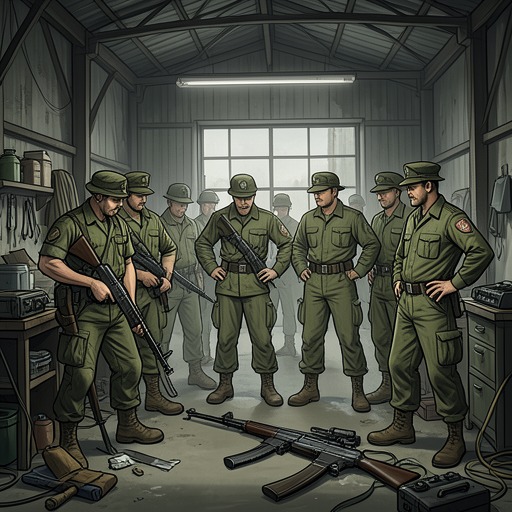
The D-boys nevertheless returned to the hangar ready to resume the fight. After an early helicopter lift back, they cleaned their weapons, checked their gear, and replenished their ammunition; they were prepared to go out again. The contrast between that readiness and the mounting casualties did not make the mission’s danger disappear. Instead, it illustrates an organizational response grounded in continued preparation: even after the raid had become a protracted battle, the commandos treated re-equipping as a step toward renewed action.
Morale and Self-Image
As Ramaglia was loaded onto a helicopter, a medic told him he felt sorry for the men. Ramaglia turned the sympathy outward, saying the opposing side deserved it because the D-boys had won. His retort gives the unit a voice beyond its operational assignments: even as the battle’s casualties were being counted, one commando answered exhaustion and loss with a blunt assertion of collective pride.